
 Skip to content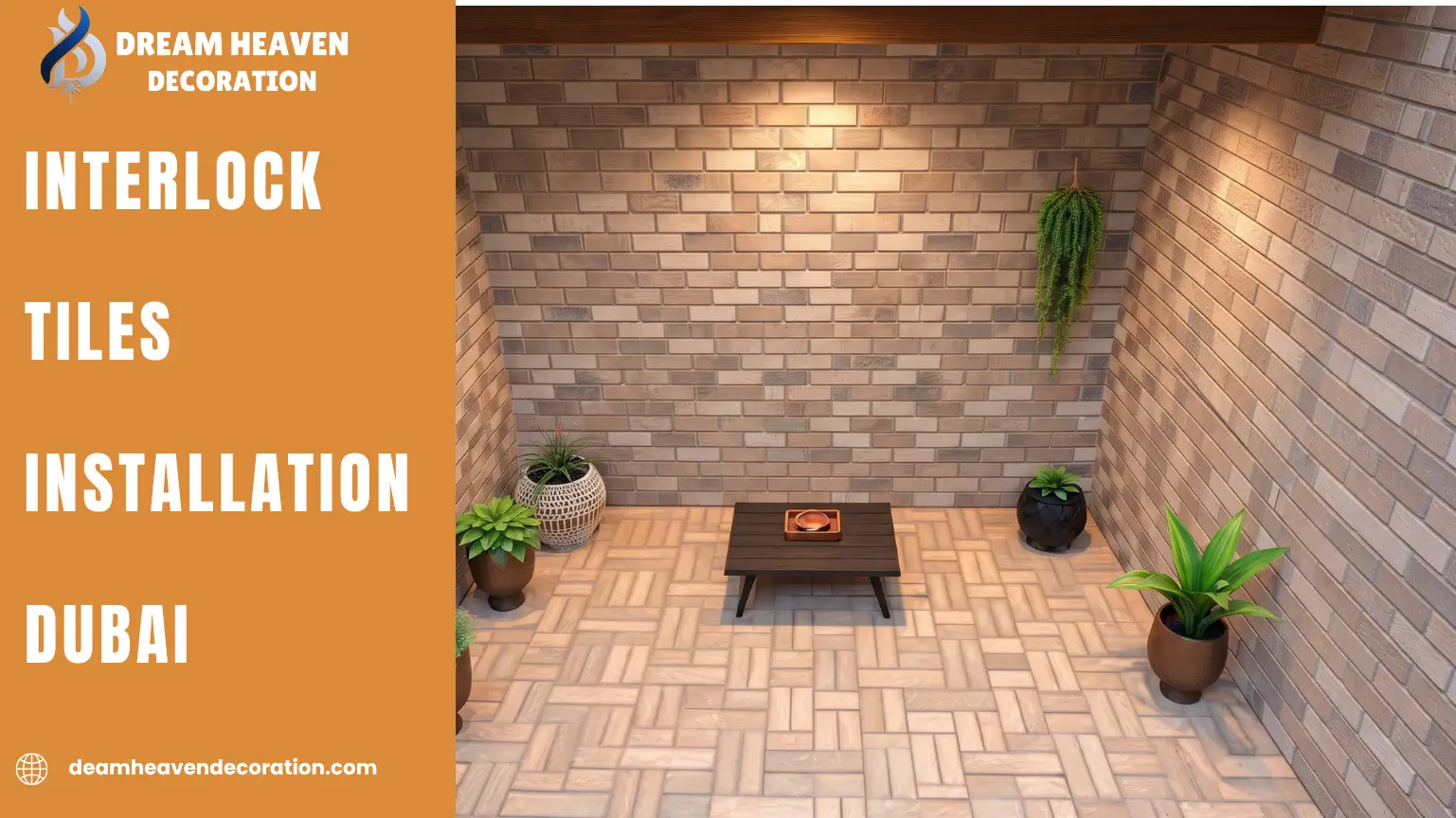
Pull into almost any older Dubai villa, and you’ll spot the same story: a driveway with hairline cracks running through it, or a garden path where weeds have pushed their way up between the slabs. Plain concrete and standard tiles just don’t hold up well here — the heat expands them, the ground shifts, and eventually something gives. That’s why so many homeowners are forced to use interlock tiles instead. They bend slightly rather than break; they allow water to go through rather than build up; if one is damaged, you can lift it up and replace it without harming the other tiles.
This guide covers what you actually need to know before starting an interlock project — what the tiles are, realistic AED pricing, how the installation is done, and the mistakes that cause most of the complaints you’ll read online. If you’re weighing up flooring options more broadly, our tiles installation Dubai page covers indoor and outdoor work beyond just interlock.
Interlock tiles are precast concrete, clay, or stone blocks cut to fit tightly against each other without any mortar or cement holding them in place. That interlocking shape is the whole point—it lets the surface move very slightly under heat and pressure instead of splitting, which matters a lot when ground temperatures here can climb past 60°C in summer.
A few reasons people choose them over concrete or ceramic outdoors:
Not every job calls for the same tile. Roughly speaking, here’s what gets used most:
The type you pick shouldn’t just come down to appearance — thickness has to match what the surface will be dealing with, which ties into a mistake we’ll get to shortly.
Three things drive the price: how much area you’re covering, which tile and thickness you go with, and whether there’s an old surface to remove first. Here’s a realistic range for 2026:
Area/Use | Material Cost (per sqm) | Installation Cost (per sqm) | Notes |
Garden path (60mm concrete) | AED 35–50 | AED 20–30 | Foot traffic only |
Driveway (80mm concrete) | AED 50–80 | AED 25–35 | Rated for cars |
Heavy-duty driveway (100mm) | AED 70–100 | AED 30–45 | Rated for trucks/heavy vehicles |
Pool deck (textured/anti-slip) | AED 80–150 | AED 30–40 | Slip-resistant finish |
Natural stone/premium | AED 100–200 | AED 35–50 | Higher-end aesthetic |
On top of that, factor in old surface removal if there’s existing paving to clear, plus roadbase gravel and sand bedding, which usually adds another AED 15–20 per square meter combined. Honestly, the only way to get an exact figure is a site visit — ground condition alone can swing the total by quite a bit.
Done properly, an interlock surface should hold up for well over a decade. Here’s roughly how a job goes from start to finish:
This part is where things tend to go wrong if it’s rushed — a poorly compacted base is by far the most common reason pavers start sinking a year or two in. Our hardscaping Dubai team handles everything from the excavation stage through to sealing.
A few things make a real difference in Dubai’s climate specifically:
If you’ve ever read a complaint about interlock tiles cracking or sinking within a year, it almost always traces back to one of these:
Since the workmanship matters more than the tiles themselves, it’s worth asking any contractor a few direct questions:
At Dream Heaven Decoration, we start every interlock job with a free site visit so the quote reflects your actual ground condition rather than a generic estimate. If you’re planning a bigger outdoor refresh, we also handle the surrounding landscaping services — planting, irrigation, lighting — alongside the paving.
Between AED 55 and AED 150/m², which includes material and labor. This will vary based on the thickness of the tile, material, and site conditions.
Yes, for driveways, gardens, and pool decks. Unlike standard ceramic tile, Interlock flexes and drains easily with heat and doesn't crack with time outdoors.
The average lifespan is 15-25 years with a well-compacted base and minimal maintenance. The early failures are mostly due to the way the base is prepared, rather than to the tiles.
Herringbone is typically used on driveways, as it distributes vehicle weight fairly evenly. For paths and patios, basketweave and running bond are great options.
A small garden path may be feasible for the homeowner to make themselves. Drives should be properly compacted and load distributed and should be considered as compaction and load distribution are important factors for driveways—and it's worth having a licensed installer come in and avoid any potential future sinking or cracking.
Whether it’s a driveway that’s seen better days, a new garden path, or a pool deck upgrade, getting the base right from the start saves you money later. Book a Free Consultation and we’ll take a look at your space and put together an accurate, no-obligation quote.
At Dream Heaven Decoration, we believe trust is built through transparency, quality, and commitment. Every project we take on is guided by strict standards to ensure excellence and client satisfaction from start to finish.
Projects completed on schedule without compromising quality.
Every step is tailored to match your vision perfectly.
Contact our Experts for a customized quote and consultation.
© 2026 Dream Heaven Decoration. All Rights Reserved.
 Optimized by Seraphinite Accelerator