 Skip to content
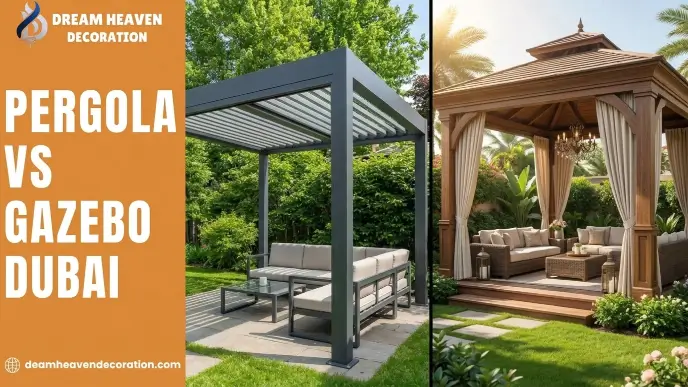
Stand in almost any villa garden in Arabian Ranches, Jumeirah Golf Estates, or Dubai Hills, and you’ll notice outdoor shade structures have become as central to the design as the landscaping itself. The question homeowners consistently run into is which structure actually makes sense: a pergola, with its open, airy framework, or a gazebo, with its fully enclosed roof and more traditional silhouette.
They’re often shown side by side in marketing photos, but they solve genuinely different problems. This guide breaks the comparison down clearly — what each structure actually is, how they perform against Dubai’s climate specifically, what they cost, and which one fits which type of outdoor space.
What Is a Pergola?
A pergola is an open-sided outdoor structure made up of vertical posts supporting an overhead framework of beams, slats, or louvers. Rather than a solid, fully enclosed roof, a pergola’s top is designed to filter light rather than block it out completely — creating partial shade while still allowing airflow and natural light through.
In Dubai, pergolas are typically built from aluminum or powder-coated steel rather than natural wood, since timber tends to warp and weather poorly under the region’s intense, near-constant sun exposure. Modern pergolas frequently include adjustable or motorized louvered roofing, allowing homeowners to control light and ventilation depending on the time of day or season.

What Is a Gazebo?
A gazebo is a freestanding structure — usually octagonal, round, or square — with a solid, often decorative roof and open or partially open sides. Unlike a pergola, a gazebo offers full shelter from sun, wind, and rain, functioning more like a small, standalone outdoor room than an airy garden feature.
Gazebos tend to carry a more traditional, decorative character, often featuring a peaked or domed roof, and are commonly positioned as a garden’s focal point rather than blended directly into the main living area the way a pergola typically is.

Find the Right Structure for Your Garden
Call to action today — book a free consultation with the Dream Heaven Decoration team.
Book a Free ConsultationPergola vs Gazebo: The Core Differences
| Feature | Pergola | Gazebo |
|---|---|---|
| Roof structure | Open lattice, slats, or louvers | Solid, fully enclosed roof |
| Shade level | Partial shade, filtered light | Full shade and shelter |
| Airflow | Excellent — open design maximizes breeze | More limited due to enclosed roof |
| Typical shape | Rectangular or square | Octagonal, round, or square |
| Placement | Often attached to the home or blended with the garden | Usually freestanding, positioned as a focal point |
| Materials commonly used in Dubai | Aluminum, powder-coated steel | Aluminum, steel, sometimes treated wood with weatherproof roofing |
| Weather protection | Sun filtering, limited rain protection | Full protection from sun, wind, and rain |
| Typical cost | Generally more budget-friendly | Generally more expensive due to solid roofing and additional features |
| Best suited for | Lounging, dining zones, poolside areas, walkways | Formal entertaining, year-round shelter, garden focal points |
How Each Structure Performs in Dubai's Climate
This is where the decision really matters, since Dubai’s climate places real demands on outdoor structures that a generic comparison doesn’t always account for.
Sun and Heat
Both structures provide meaningful shade, but they handle it differently. A pergola filters sunlight rather than fully blocking it, which some homeowners actually prefer for softer, dappled light — though it offers less complete protection during the most intense midday hours unless paired with retractable shade curtains or a louvered roof system. A gazebo, with its solid roof, delivers complete shade regardless of the sun’s position, making it a stronger choice for anyone prioritizing consistent, full coverage over airflow.
Airflow and Ventilation
Pergolas have a clear advantage here. Their open-sided, open-roof design allows breeze to move freely through the space, which genuinely improves comfort during Dubai’s warmer months, when trapped, still air under a fully enclosed structure can feel stifling even in the shade. Gazebos, by contrast, can feel noticeably warmer inside during peak heat, since their enclosed roof limits natural airflow.
Wind and Sandstorms
Gazebos, with their more solid construction and partially enclosed sides, generally offer better protection during Dubai’s occasional strong winds and sandstorms. Pergolas, being more open, let dust and wind pass through more easily — which can be an advantage for airflow but offers less shelter during a sandstorm specifically.
Rain Protection
Neither structure is a substitute for full indoor shelter, but gazebos, with their solid roofing, offer meaningfully better protection during Dubai’s occasional heavy rain events. A standard pergola’s slatted or louvered roof will let rain through unless it’s fitted with a retractable or solid-panel roofing option, which some modern pergola designs now offer as an upgrade.
Material Durability
Both structures perform best in Dubai when built from aluminum or powder-coated steel rather than natural wood, which weathers poorly under sustained UV exposure and heat over time. Quality weatherproof roofing materials matter significantly for gazebos specifically, since the solid roof takes the brunt of both sun exposure and any rainfall.
Cost Comparison
Pergolas are generally the more budget-friendly option, largely due to their simpler open-frame construction. Gazebos tend to cost more, since their solid roofing, more complex structural design, and often additional features like built-in seating or decorative detailing add to both material and labor costs.
That said, cost for both structures varies significantly based on size, material quality, and added features — a fully motorized, louvered aluminum pergola with integrated lighting can cost considerably more than a basic gazebo, so it’s worth getting a detailed quote based on your specific design rather than assuming one option is automatically cheaper across the board.
Which One Should You Choose? A Scenario-Based Guide
Choose a Pergola If...
- You want a space that blends naturally with your home’s architecture and garden, rather than standing apart as a separate structure
- Airflow and natural light matter more to you than complete shade
- You’re creating a poolside lounging area, an outdoor dining zone, or a garden walkway
- You like the idea of climbing plants or vines eventually growing into the structure for a softer, more natural look
- You want flexibility to add retractable shade curtains, outdoor fans, or lighting later without the structure feeling crowded
Choose a Gazebo If...
- You want complete, reliable shelter from sun, wind, and occasional rain
- You’re designing a formal entertaining space or a dedicated garden focal point
- You host guests or family gatherings that need consistent shade regardless of time of day
- You prefer a more traditional, decorative aesthetic in your garden
- Your outdoor space would benefit from a clearly defined, self-contained “room,” rather than an open extension of your main living area
Consider Both
Larger villa gardens in Dubai increasingly use both structures together — a pergola connecting the home to the garden for everyday lounging and dining, paired with a gazebo further out as a more formal, sheltered focal point for entertaining or quiet relaxation. This isn’t necessary for every property, but it’s worth considering if your garden has the space to support more than one distinct outdoor zone.

Maintenance Considerations
Both structures require relatively low ongoing maintenance when built from appropriate materials, but there are some differences worth knowing.
Pergola Maintenance
Aluminum and powder-coated steel pergolas need only occasional cleaning to remove dust and debris. If a louvered or motorized roofing system is installed, periodic checks of the mechanism are worth budgeting for to ensure smooth operation over time.
Gazebo Maintenance
The solid roof structure needs periodic inspection for wear, particularly after sandstorms or heavy rain, to confirm the roofing material remains properly sealed and secure. Any built-in seating, curtains, or screens should also be checked and cleaned regularly to keep the space looking its best.
Common Mistakes to Avoid
- Choosing Based on Appearance Alone. A stunning design in a photo doesn’t guarantee the structure suits your climate needs — always weigh airflow, shade level, and weather protection alongside aesthetics before deciding.
- Underestimating Wind and Sandstorm Exposure. If your property is in a particularly open or exposed area, factor this into your choice and material selection, since it genuinely affects how each structure performs over time.
- Using Untreated or Standard Wood. Natural wood that isn’t specifically treated and rated for Dubai’s climate will weather and warp far faster than aluminum or powder-coated steel alternatives.
- Skipping a Site Assessment. Garden dimensions, existing landscaping, and how the structure connects (or doesn’t) to your home all affect which option — and which specific design — genuinely fits your space. A proper site visit before committing avoids costly redesigns later.
- Not Planning for Future Additions. If you might want to add lighting, fans, retractable curtains, or a projector setup later, mention this during the design stage so the structure can accommodate those additions without feeling crowded or requiring rework.

See Our Latest Projects
Explore pergolas, gazebos and outdoor spaces we have completed across Dubai.
Our PortfolioFrequently Asked Questions
Is a pergola or gazebo better for a Dubai pool area?
Which is more expensive, a pergola or a gazebo?
Can a pergola provide full shade like a gazebo?
Do gazebos get too hot inside during Dubai summers?
Can I install both a pergola and a gazebo in the same garden?
Conclusion
Neither structure is objectively better — the right choice depends entirely on what you actually want from your outdoor space. A pergola suits homeowners who prioritize airflow, natural light, and a design that blends seamlessly with the home and garden, while a gazebo suits those who want complete, reliable shelter and a more defined, formal outdoor space.
Before committing to either, walk through how you’ll actually use the space, get a proper site assessment, and ask any contractor directly how their specific materials and design will hold up against Dubai’s heat, wind, and occasional rain. Getting that match right is what turns either structure into a space you genuinely use year-round, rather than one that looks good in photos but sits empty during the months it matters most.
Not Sure Which Fits Your Garden?
Book a free consultation and Dream Heaven Decoration will assess your garden before you commit to a structure.
Book a Free ConsultationGuarantees & Policies
At Dream Heaven Decoration, we believe trust is built through transparency, quality, and commitment. Every project we take on is guided by strict standards to ensure excellence and client satisfaction from start to finish.
On-Time Delivery
Projects completed on schedule without compromising quality.
Customer Satisfaction
Every step is tailored to match your vision perfectly.
Get a Free Quote
Contact our experts for a customized quote and consultation.
