 Skip to content
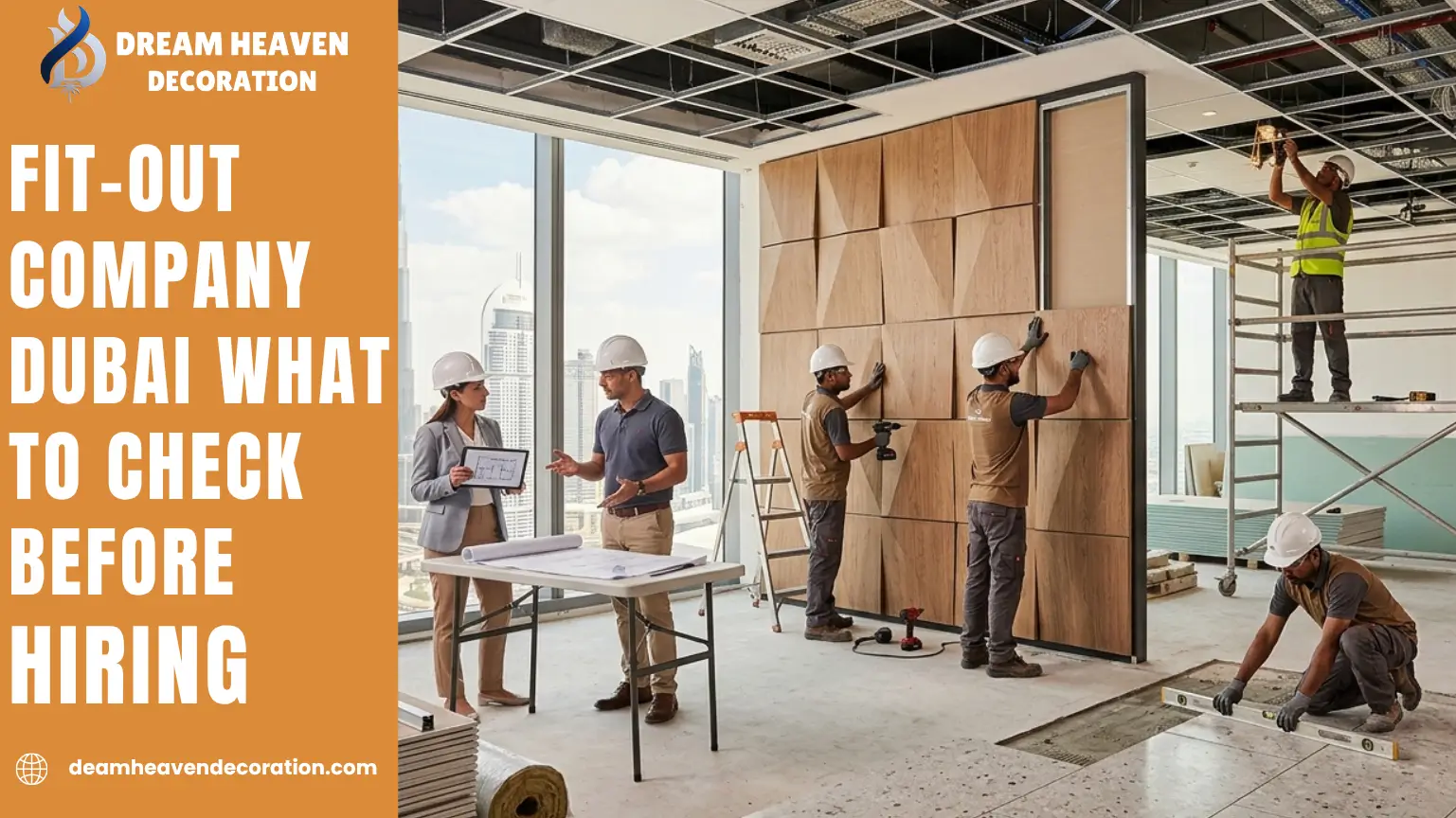
Dubai does not forgive poor decisions — especially when it comes to choosing a fit-out company. The market is full of contractors making big promises, but hiring the wrong one means delayed projects, hidden costs, authority violations, and spaces that fall apart within months.
Whether you are fitting out a villa, apartment, office, or full property with outdoor spaces, this guide gives you a clear, practical checklist of everything to verify before you sign anything.
Quick Answer: Hiring a Fit-Out Company in Dubai
- Verify the trade licence first: it must list fit-out, interior contracting or decoration as a registered activity.
- Confirm they handle approvals from DM, Civil Defence, DEWA, DDA or Trakhees where relevant, and the building NOC.
- Review completed projects in person, not just photos.
- Benchmarks: AED 150–250 (budget), 300–500 (mid-range), 600+ (premium) per sq ft.
- Insist on an itemized quote, milestone payments, and a minimum 12-month defect liability period.
- Be wary of 60–80% upfront payment demands.
Cost figures are approximate benchmarks and vary by scope and finish.
What Does a Fit-Out Company in Dubai Actually Do?
Fit-out is the complete process of transforming an empty or basic space into a fully functional, finished environment. This covers space planning, flooring, ceiling works, partitions, MEP installations, joinery, lighting, décor, and final handover. In Dubai, fit-out spans three main categories:
Residential
Villas, apartments and townhouses.
Commercial
Offices, retail stores, restaurants, clinics and showrooms.
Outdoor
Landscaping, swimming pools, pergolas and exterior finishing.
What makes Dubai unique is the regulatory requirement. Every fit-out project here needs proper authority approvals before work begins. This is exactly why choosing the right fit-out company in Dubai matters more than in most markets.
Check the License and Trade Registration First
This is the single most important step, and it takes five minutes.
Every legitimate fit-out company in Dubai must hold a valid trade license from Dubai Economy and Tourism (DET) or the relevant free zone authority. The license must specifically list fit-out, interior contracting, or decoration as a registered business activity.
What to ask for:
- Trade license copy — before any discussion moves forward.
- Confirmation that fit-out is listed under registered activities.
- RERA registration for residential projects.
- ISO certifications for quality assurance.
- UAE Land Department recognition.
If a company hesitates to share their license, that is your answer. Walk away.

Hire a Fully Licensed Fit-Out Company
Call to action today — book a free consultation with the Dream Heaven Decoration team.
Book a Free ConsultationConfirm Their Authority Approval Expertise
This is where the most expensive mistakes happen. Starting fit-out work without proper permits in Dubai can result in project shutdowns, heavy fines, and forced removal of completed work.
| Authority | What It Covers |
|---|---|
| Dubai Municipality (DM) | Approves architectural, structural and MEP drawings for most residential and commercial projects. |
| Dubai Civil Defence (DCD) | Mandatory fire safety approval for all commercial fit-outs. |
| DEWA | Required for any electrical or plumbing system modifications. |
| Dubai Development Authority (DDA) | Governs free zones like Media City, Design District and Internet City. |
| Trakhees / PCFC | Covers JAFZA, Dubai South and Nakheel zones. |
| Building Management NOC | Required from developers like Emaar, Nakheel and Meraas before any contractor enters the site. |
Evaluate the Portfolio the Right Way
Every company has a portfolio. Not every portfolio proves real capability.
- Request a site visit to a completed Dubai project similar to yours; photos can be borrowed from anywhere.
- Check finishing quality in person. Tile alignment, ceiling joints, joinery edges and paint precision reveal the true standard.
- Match it to your project type. A villa portfolio for a villa, an office portfolio for an office.
- Ask if projects were turnkey. Full design-to-handover projects show more capability than partial trade work.
- Confirm 3D visualization is offered. It is now standard among professional fit-out companies in Dubai; without it, you are committing to a major investment without seeing what you are buying.

Turnkey vs. Multiple Contractors: What Works Better in Dubai
Hiring separate vendors for design, fit-out, landscaping, and outdoor works creates coordination problems that most clients underestimate. Schedules clash, design visions fragment, authority submissions become duplicated, and when something goes wrong, every vendor points at someone else.
A full-service fit-out company in Dubai that handles interiors, outdoor spaces, pools, pergolas, and authority approvals under one roof delivers:
One Contract
Covering all scope.
One Project Manager
Owning the timeline.
One Set of Authority Submissions
No duplicated paperwork.
A Unified Design
Across every space, indoor and outdoor.
For Dubai villas and larger properties where gardens, pools, and outdoor areas carry equal visual weight to the interiors, this integrated approach does not just save time — it produces a genuinely better result.
Assess Their Project Management Structure
Great design with poor project management still delivers a disappointing result. This is what separates companies that finish on time from those that drift into delays and cost overruns.
- Dedicated project manager assigned before work begins, not just during the sales phase.
- Manageable workload. Ask how many active projects they handle simultaneously.
- In-house team rather than daily subcontracted labor. In-house teams maintain better quality control.
- Milestone-based timeline provided before signing, covering design, approvals, execution phases, snagging and handover.
- Clear communication structure: weekly updates, site reports, and a single point of contact throughout.
If a company cannot produce a project timeline before work starts, their organization is not at the level your project requires.

Understand the Full Cost Structure
Dubai fit-out cost benchmarks:
| Finish Level | Approximate Cost Per Sq Ft |
|---|---|
| Budget | AED 150 – 250 |
| Mid-Range | AED 300 – 500 |
| Premium / Luxury | AED 600 and above |
Always request a fully itemized quotation, not a lump sum. Each line item should specify materials by brand and grade, not just category.
Hidden costs to watch for:
- Variation orders — charges for any change made after signing.
- Material substitutions — cheaper alternatives used without your approval.
- Authority approval fees excluded from the original quote.
- Waste disposal charges added post-signing.
What Must Be in the Contract
A detailed contract is your only real protection once work begins. Never sign anything that is vague or contains blank sections. Non-negotiable elements:
Full Scope of Work
A category-by-category breakdown, not a general description.
Material Specifications
Brand, grade, finish and origin for all key materials.
Milestone-Based Payments
Tied to verified on-site progress.
Start and Completion Dates
With a delay clause.
Warranty Terms
Reputable companies offer a minimum 12-month defect liability period; get this in writing.
Snagging Process
Who conducts the walkthrough, the timeline for fixes, and final payment released only after snagging sign-off.
Red Flags to Watch Out For
These warning signs are specific and observable. Take them seriously.
- Hesitation or refusal to share the trade license.
- Portfolio with no real Dubai projects, only renders or stock images.
- A quote dramatically lower than every other company.
- No written contract offered.
- Upfront payment demand of 60% or more before meaningful work starts.
- Claims that authority approvals are not required for your project.
- Everything is subcontracted, with no in-house execution team.
- No 3D visualization offered before execution.
- Poor responsiveness during the consultation phase.
- No defined warranty or after-service process.
Why Choose Dream Heaven Decoration as Your Fit-Out Company in Dubai?
With so many options in the market, here is what makes Dream Heaven Decoration the right choice for your project:
Fully Licensed & Certified
Recognized by the UAE Land Department, RERA and Abu Dhabi Municipality, so your project is always compliant and protected.
Complete Under One Roof
Interior design, fit-out, landscaping, swimming pools, pergolas, kitchen design, flooring and exterior finishing, with no need to manage multiple vendors.
Authority Approvals Managed
We handle all submissions to Dubai Municipality, Dubai Civil Defence, DEWA and developer NOC requirements on your behalf.
3D Visualization Included
You see and approve your complete design before a single wall is touched.
Dedicated Project Manager
One point of contact from the first meeting through to final handover.
In-House Execution Team
Our own skilled professionals handle the work, ensuring consistent quality and accountability.
Transparent Pricing
Fully itemized quotations with material specifications included, no hidden charges.
12-Month Warranty
We stand behind our work with a full defect liability period after handover.
Residential, Commercial & Outdoor
Whether it is a luxury villa, a corporate office, or a full outdoor transformation, we deliver it all with the same standard of excellence.
Dream Heaven Decoration does not just complete your project — we take full ownership of it from day one. That is the difference.
See Our Latest Projects
Explore the fit-out projects we have delivered across Dubai.
Our PortfolioFrequently Asked Questions
What should I check before hiring a fit-out company in Dubai?
Do fit-out companies in Dubai handle authority approvals?
How much does a fit-out cost in Dubai?
What is the difference between turnkey fit-out and partial fit-out?
How long does a fit-out project take in Dubai?
Conclusion
Choosing the right fit-out company in Dubai comes down to verified licensing, authority approval expertise, an honest portfolio, a transparent cost structure, and a solid contract. Take the time to ask every question in this guide — a company with nothing to hide will welcome all of them.
Dream Heaven Decoration is a fully licensed interior design and fit-out company in Dubai, handling residential, commercial, and outdoor spaces across the UAE. Contact us today for a free consultation.
Book a Free Consultation
Contact us today for a free consultation on your fit-out project.
Book a Free ConsultationGuarantees & Policies
At Dream Heaven Decoration, we believe trust is built through transparency, quality, and commitment. Every project we take on is guided by strict standards to ensure excellence and client satisfaction from start to finish.
On-Time Delivery
Projects completed on schedule without compromising quality.
Customer Satisfaction
Every step is tailored to match your vision perfectly.
Get a Free Quote
Contact our experts for a customized quote and consultation. Request Quote, call +971 55 410 0325, or WhatsApp us.
